Recording the Newsletters issued by Casino Community Garden, located on the corner of Adam and Hartley Streets
(adjacent to entrance to Queen Elizabeth Park), South Casino, NSW, Australia.

The garden is a project of Casino Neighbourhood Centre, overseen by the Community Development Project Coordinator. As the flier concerning community gardens says, it is a place of beauty, joy, peace and kindliness, and friendliness too.

All links active at time of publication. Please report any broken link you come across to Jan. Thank you.

6 November 2013

NEWSLETTER NOVEMBER 2013


CASINO COMMUNITY GARDEN
Monthly Newsletter #9 Issued November 2013

Around Casino Community Garden this Month

Every Tuesday from.30am:  Join in at the garden with the regular gardeners, weeding, general garden activities, and planting still going on.

Gardening Wednesday morning also:  Help also needed with watering, pop down Tuesday or Wednesday morning to make arrangements if you can hel over Summer.

Every Wednesday 12 noon:  BYO lunch gatherings every week at the garden - come on down at noon and have a bite to eat, a cuppa and join in the chat with the regulars.  Topics include good food, gardening and healthy living.

Monthly Meeting first Wednesday of Month:  Lunch 12 noon, MEETING 12.30 for about an hour.  Any change sent to email list and on Facebook.
Shirley planting Rosellas after a Wednesday lunch


 Welcome to Summer Garden Clinic

The next event in the calendar this year will be the Welcome to Summer Garden Clinic on Saturday 30th November.

The event, starting at 9.00am and running until lunch, will showcase some local talent with speakers including Vicki Stebbins from Tabulam who will talk about "preserving your harvest", Roz Borrell will demonstrate No-Dig Gardens and David Copperthwaite from Nickel Energy will be talking about solar power options.  As published in the Casino Neighbourhood centre Community Newsletter, Jo commented  "We are always pleased to have interesting local speakers at our garden events.  This is a great opportunity for us all to learn more about growing food and taking care of our backyards, and the Community Garden is the ideal place to do it." Words Jo Nemeth.

CCGarden featured in RVC our communit-e News Issue 1


Great to see four paragraphs about Casino Community Garden in the first issue of Richmond Valley Council's Community News.

 "COMMUNITY GARDENS THRIVE IN SPRING
Jean, Agnes, Mark, Shirley, Andrew, Ric and Owen

 Spring is the perfect time for gardening - the flowers are in bloom, the weather is fine and a visit to a community garden also brings with it the pleasure of socialising, sharing ideas and contributing to your local community. The Casino Community Garden adjacent to Queen Elizabeth Park in Hartley Street goes from strength to strength, in September picking up best community garden project in the Casino & Districts Garden Club awards.
  
Community development worker Jo Nemeth from the Casino Neighbourhood Centre has worked closely with the community volunteers and businesses with their latest initiative designed to make the gardens access-friendly for people with a disability. Twenty nine businesses have signed up to sponsor a section of the access path, where wheelchairs, zimmer frames and mobility challenged are able to traverse the gardens in all their glory. Novaskill’s Construction Certificate II group will build the path in coming months.
  
The garden group also plans to install a plumbed-in sink to complement the pizza oven and undercover meeting area where volunteers get together to share tips and have a laugh on Wednesday lunchtimes. A second tool shed has been built by local builder Dave Geurts, an ideal addition to complete facilities at the garden. The garden is growing in leaps and bounds with seasonal salad vegetables thriving alongside a great variety of herbs.
  
To get involved, you can donate your time by labouring, weeding, planting and watering, get creative in construction and art projects, or donate second hand sleepers, outdoor paint, broken tiles for a mosaic feature, vegetable seedlings, climbing frames, fruit trees or bush food plants. Any volunteer can enjoy a selection of the harvest for their efforts. The group meets every Tuesday for a working bee from 9am. A special event is planned for Saturday 30 November with guest speakers invited to the morning tea/lunch get together.
  
For more information about getting involved at the Casino Community Garden, call Jo from Tuesday to Thursday on (02) 6662 5435 or email coordinator.cdp@cnci.org.au"

Pizza Oven

Our thanks to Owen and Mark for rendering the Pizza Oven.  Plns to decorate the oven to look like a ladybird were rnthusiastically received.  Jo to print up rules for use of oven, laminate it and display near oven.
Owen, Jo and Mark at meeting with rendered pizza oven in background.

Youth Service Seat
Thanks to Hurfords Sawmill for donation of timber for the Youth Service Seat with the assistance of longstanding CCGarden supporters Les and Sue from Casino Garden and Landscape.  Plans are in hand to mosaic the seat.


Use Water Wisely
Casino Community Garden is aware water is a precious resource and is committed to wise water use.

Reading and Inspiration for November
Barry and Jan Brine

We have friends who would like to ferment vegetables for the probiotics and have been daunted by the prospect.  So when we made a jar last week, I took some photos.

When we first decided to give it a try, we googled and read books, and jut got confused.  Then we were n Fundies in Lismore looking for special containers and additives and the guy there said "all you need is a large glass jar and a smaller to put water in that fits in it to hold the veggies down."  jar about $3.50-$5 at discount shops.  A friend recommended an airlock available at brewing suppliers.

This time we made one jar and used a smaller glass to hold veggies down.

Use organic vegetables if possible for the healthiest product.  We usually make one or two jars as they are stored in the refrigerator after fermentation.  This took approx 30 minutes, finished at 3pm and veggies were fermenting next morning.

1. Preparation and ingredients for one jar.

Approx 1/3 cabbage
Cup cauliflower florets
1/3 capsicum
2 apples
1 red onion
5cm ginger
2 teaspoons  Himalayan salt

2. Save two outer cabbage leaves per jar

3. Roughly cut vegetables

4. If using cauliflower, cut florets rather than processing


 5.  After processing, knead veggies to release (sorry I didn't get a pic).  Stale veggies do not produce juice.


 6. Move veggies into jar

7. Cut saved cabbage leaves, two per jar, then halve.


8. Criss-cross leaves across top of veggies to hold down, then put weight in.  If too much juice (as shown here) discard some.  Put lid on.

9. Leave on counter.
Veggies fermenting next morning. See a ring of tiny bubbles around top, and larger bubbles moving upwards.

Fermentation takes 3-7 days then refrigerate.  We have made 8+ batches and all fermented and refrigerated after 4-5 days. To serve strain liquid off.
Store in refrigerator in capped glass jar.
A tasty and healthy addition to salads and snacks.

Please seek advice if you have any doubts or questions.

Summary about fermentation by recognised expert Sandor Katz.

Kale

"Kale is powerful stuff. Packed with vitamins and minerals such as vitamin K, A, C, manganese and fiber.  This leafy green is a must in your diet with its anticancer and anti-inflammatory properties, kale also helps you maintain a healthy cardiovascular system,  Kale contains two powerful antioxidants making it good at fighting off free radicals.  Kale aids phase 1 and 2 of the detox process.  Be sure to include kale in your diet to help you feel and look great.

More here


Here is a recipe on FB from Food Babe who said kale changed her life

Melt In Your Mouth Kale Salad
 
Prep timeTotal time
Author:
Serves: 2
Ingredients
  • 1 bunch of  kale, stems removed, rinsed and patted dry
  • ⅓ cup currants (or chopped raisins)
  • juice of one lemon
  • 1 tbsp of olive oil
  • 1 tsp local honey
  • ½ cup pine nuts toasted
  • salt and pepper to taste
  • 4 tbsp grated raw parmesan cheese
Instructions
  1. In a food processor, process kale into small chopped pieces
  2. To make dressing, stir lemon juice, olive oil, honey, salt and pepper together in a large bowl
  3. Add chopped kale, currants, pine nuts and parmesan to bowl with dressing
  4. Stir all ingredients together and serve
  5. (Optional – Save some pine nuts and/or parmesan cheese for top of salad before serving for presentation purposes)
Notes
**Choose all organic ingredients if possible**

Next Month: Shirley's scrumptious Tomato Relish that we enjoyed at the Garden today, on her beautiful home made bread.  Thanks Shirley!
 

November in your Garden (from 2012 edition)
by Helen Tuton SGA

It's now late in Spring and gardens are full of bright new growth and a wealth of flowers. Nasturtiums, among the herbs, not only make a cheery and pretty welcome but the sweet peppery taste of both flowers and leaves make a stimulating addition to salads.

With the festive season fast approaching, now is the time to get the garden looking great for the series of celebrations that roll around at this time of year.

Add some colour
Why not try some lovely flowering stuff in your patch like alyssum, chamomile, cosmos, sunflowers, nasturtium, dianthus, gerbera, verbena, snapdragons, petunias, Shasta daisies, marigolds, phlox and celosia.  These guys not only pretty up your patch, they are great at attracting pollinators and beneficial insects as well.

Sunscreen for your plants
The Aussie sun can be pretty intense at times and can burn some sensitive plants.  So head out to the shed and construct a couple of shade cloth tents.  They don't have to be elaborate, just a simple moveable structure that you can place over the top of some of the more susceptible vegies (like eggplant, capsicum, tomato and others) as the heat becomes more intense.  Think of it as slip slop, slap for plants.

Check your grafted fruit trees.
Have a look at your grafted fruit trees throughout November.  If there are any shoots appearing below the graft it's best to remove these at once.  Your tree will thank you for it.

Thanks to SGA - Sustainable Gardening Australia

A couple of pics around CCGarden on meeting day.

 Brad, Andrew, Keith, Shirley Owen, Jo, Mark, Liz and a couple of people had to leave early

  
Delightful welcome at the entrance

Vegetable Planting Guide by Gardening Australia
For November

Amaranth, artichoke (globe), asparagus pea, basil, beans - climbing and bush, beetroot, burdock, cabbage (loose head), capsicum, carrotts, chilli, chives, choko, coriander, cucumber, eggplant, huauzontle, lettuce, long yam, luffa, Malabar greens, mustard greens, okra, oregano, pumpkin, radish, rocket, rockmelon, rosella, salsify, silverbeet, squash, sunflower, sweet corn, sweet potato, tomatoes, turnip/Swedes, Warrigal greens, NZ spinach, watermelon, zucchini.
Zucchini coming on at CCGarden
---oooOooo---

Suggestions and photos welcome, by email to Jo or
or bring to lunch Wednesdays or the meetings.
Ask Jo about being a member of the Garden - $5/annum

Join us on Facebook
67 'likes' on our Facebook page now!!!!

If new here,don't forget to check out back issues of the Newsletter.

Words and photos by Jan Brine unless otherwise stated.
_________________________

Casino Community Garden
A Project of the Casino Neighbourhood Centre
Contact: J Nemeth on 6662 5435   Email:coordinator.cdp@cnci.org.au
Location of Garden: Head for entrance to Queen Elizabeth Park at South Casino
Garden on left - corner Adam and Streets
 _______________________


9 October 2013

NEWSLETTER OCTOBER 2013

Please excuse the variations in font etc this month, just seems to be glitches at time of posting.

CASINO COMMUNITY GARDEN
Monthly Newsletter #8 Issued October 2013

Around Casino Community Garden this Month

Every Tuesday from 8.30am: Join in at the garden with Jo, Janine, Mark and Kevin, weeding, general garden activities, and planting still going on.


Gardening Wednesday morning also.  Help also needed with watering, pop down Tuesday or Wednesday morning to make arrangements if you can help over Summer.


Every Wednesday 12 noon:  BYO Lunch gatherings every week at the garden - come on down at noon and have a bite to eat, a cuppa and join in the chat with the regulars, topics include good food, gardening and healthy living.


Monthly Meeting :  Lunch 12 noon, MEETING 12.30 for about an hour usually on first Wednesday of month, any change advised by email and on Facebook.
 Janine working in the herb garden just before the October meeting.

News from the October Meeting

Next Event: Welcome to Summer

Saturday 30th November from 9am to 12 noon with morning tea, and lunch following.

It is hoped the heat of the day will be avoided with this time-frame.
Topics were nominated at the meeting and speakers to be contacted and confirmed.

Casino Garden Club competition
  
Jo stressed her thanks to all involved, past and present, for their help in bringing the garden up to such a great standard, and in particular having it looking so good for the competition.  Jo  commended the Volunteers aas an amazing group of dedicated locals who put in their time and energy not for their own benefit, but for the benefit of others.

Our thanks goes to the Casino & District Garden Club for having a new section for Community Gardens.  First prize was awarded to the Casino Community Garden.
 Shirley handing out newsletters and answering a query at the Casino Flower Show.

The Sponsorship Drive 
The sponsorship drive for the new access path for local residents and visitors with mobility issues is going well.  Already 20 businesses have committed to sponsoring a metre of the path at $80 per metre, and 29 are needed altogether.  (27 at time of going to print).

The reaction to Jo's request has been that they see it as a great cause, and are not participating for the publicity, just want to support the community!

The path will go from the accepted parking area on the QE side of the garden across to the undercover area.


Updates
Working on an update to the Procedures Manual, Membership Fees, and most importantly, the rules for the use of the Pizza Oven.

The Sheds at the Garden

Mark and Owen installing the lock on the new tool shed just before the meeting.

The sheds are now in place, a garden shed and shade house donated by Aileen Daly.

  And the new tool shed

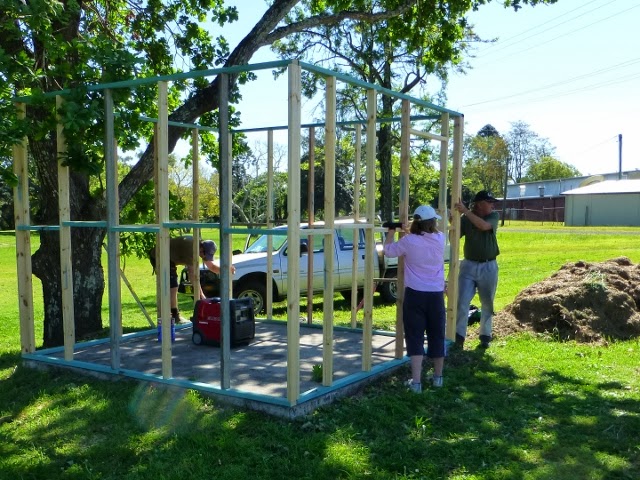
Dave Geurts at work on the new tool shed.

These three pics by Shirley Wheatley -Dave, Janine, Mark and Shirley on the day.


Reading and Inspiration for October
Companion Planting by Helen Tuton
With thanks to Sustainable Gardening Australia - Apologies if you've already seen it!
Full article and chart


Once the realm of the hardcore, hippy, home gardener, companion planting is now an incredibly popular practice – from beginner gardeners right up to large-scale agriculture. But, despite its popularity, companion planting is often misunderstood, misused and misrepresented as the “cure-all solution” to problems in the patch.
So what is companion planting? Essentially, it’s a method of growing plants together, with the idea that they will assist each other in some way, like deterring pests, improving growth, enhancing flavour, attracting beneficial insects, fixing nitrogen, disrupting “patterns” and trap cropping. But, just as we have good neighbours, there are bad neighbours as well. Some plants really dislike each other, and shouldn’t be planted in close quarters, lest one of them struggle or meet its untimely demise.

Mythbusters – Does it Actually Work?

Now, the “Big Question”: does it work? Well, yes and no. There is a fairly limited amount of actual scientific information on companion planting, but it is safe to say that some combinations do seem to work, while others can be a bit hit and miss. Why? Well, for starters, companion planting is a northern hemisphere concept that works a treat up there, but not as well down here in Australia.

Secondly, it doesn’t work so well because it isn’t understood. We’ve all heard that basil and tomatoes should be planted together, but why? How many of each is required? Is one basil per tomato enough? Who benefits? What are we deterring? Does it enhance flavour? 

Get Your Fix – Companions that Work!

Well, companion planting CAN be the quick fix, and here’s how: biodiversity! The best thing about companion planting is that it increases the biodiversity of your patch; that is, the variety of life forms in your garden. Some of the greatest companion plants in my garden are those which have nothing to do with my vegetable patch, but are the awesome locally native trees and shrubs I have planted about the place. Clever planning (if I do say so myself) has meant that my garden is never without blossom, and is therefore never without the array of critters that come with that: birds, pollinating insects (like butterflies, bees, and native wasps), reptiles, beetles and all sorts of helpful garden buddies.

By encouraging this assortment of good guys, my garden is almost completely without the bad guys, who never get a foothold in numbers that matter to me anyway! Remember, a lettuce leaf with a hole in it doesn’t require chemical warfare, nor does it signal an attack of the dreaded munchies! So now that I’ve put you off companion planting all together, let me say that I reckon there are some combinations that really work, especially those that involve plants that have a fair odour to them. Also, there are definitely combinations that dislike each other, so I’ve made for you, dear readers, what is possibly the most comprehensive companion planting chart in the known universe.

And Helen says  my favourite companion in my garden is healthy soil, full of organic matter, worms and good stuff. And beer!

Exerpt from the chart

The most comprehensive companion planting chart in the known universe (maybe)

Plant Good Neighbours How it works Bad Neighbours
Apple Nasturtium, Chives Nasturtium climbs tree and is said to repel codling moth Potatoes
Apricot Basil, Tansy, Asparagus Basil and tansy are said to repel damaging insects
Asparagus Apricot, Basil, Chives, Comfrey, Lovage, Marjoram, Parsley, Tomatoes Basil and Parsley are said to improve flavour. Onions and garlic release substances reducing growth. Garlic, Onions
Balm (Lemon) Tomatoes Attracts bees, said to enhance flavour and growth
Basil Tomatoes Basil said to repel flies and mosquitoes
Beans (climbing) Broccoli, Brussel Sprouts, Cabbage, Carrots, Cauliflower, Corn, Lettuce, Lovage, Majoram, Parsley
Beetroot, Chives, Garlic, Gladiolus, Onions, Sunflower
Beetroot Beans (bush), Broccoli, Brussel Sprouts, Cabbage, Cauliflower, Kohl Rabi, Lettuce, Lovage, Marjoram, Onion, Peas, Potato, Spinach, Silverbeet Bad Neighbours roots release substances reducing growth Beans (Climbing), Tomato
 Full chart online, plus extra tips (same link as under heading)

 Companion planting at the Garden, in the perennial section

Vegetable Planting Guide by Gardening Australia
For October


Amaranth, artichoke (globe), asparagus, basil, beans, beetroot, burdock, cabbage (loose head), capsicum, carrots, celeriac, celery, chicory, chilli, chives, choko, cocoyam, coriander , cucumber, eggplant, huauzontle,  lettuce, long yam luffa, Malabar greens, mustard greens, okra, oregano, potatoes, pumpkin, radish, rocket, rockmelon, rosella, salsify,  silverbeet, squash, sunflower, sweet corn, sweet potato, tomatoes, turnip/ Swedes, Warrigal greens, NZ spinach, water chestnut, watermelon, zucchini.


October in your garden 


October is a huge month in the patch.  With so many varieties to plant, you'll be struggling to get it all done. So, welcome to October, a fine tome to be in any sort of garden.  Remember to use all your senses in the garden.  Watch for pest issues, feel for soil moisture, smell your soil, and... most importantly.... taste the fruits (or vegetables) of your labours.

Tomatoes 
It's time to plant everyone's favourite - tomatoes.  By now your soil should be good and ready, so head to the local garden centre, pick a few varieties, and get going.  This is the moment we have all been waiting for.  don't forget their mates, Basil and French marigolds.  They are great companions, and no tomato patch is complete without them.

Sunflowers
Now is the time to plant some sunflower seeds. Find a sunny spot where you would like to see some happy sunflowers later in the year, and plant the seeds to double the depth of the seed. Cover lightly with dirt and wait… they’ll be popping their heads up in no time! !  

Remember to mulch
Top up mulch on your vegie patches, herb gardens and ornamental beds. Choose a sustainable, low environmental impact mulch that will enrich your soil as it breaks down.

Green Manure
Consider a green manure crop to add some life and love to an overworked garden. At this time of year, try clover, pigeon pea or soybean. This will improve your soil incredibly and you’ll find it well worth the effort. Young wheat is great too, it is used to make wheat grass… an incredibly vile tasting but very beneficial health tonic. Green manure crops, including clover, barley, millet and wheat are good to go now to improve that dormant vegie patch and get ready for next season’s heavy feeding plants.
.


There is still time to plant passionfruit, paw paw, avocados, banana, citrus, and macadamias. If your tastes are a little more exotic try putting in a guava. 


Thanks to SGA - Sustainable Gardening Australia   http://www.sgaonline.org.au/?p=525
Please note this link may be removed as the post is dated Oct 2011.
If so Google "October in your patch SGA" for latest


Recipe Corner
Plenty of silverbeet around now, and as well as steaming, or in your salad or stir fry, try an Impossible Pie.  Great with a side salad from your garden and when you have guests for lunch.  Serves 4 to 6 depending on what you have with it, and also nice cold.

                        4 eggs                     
                        1-1/2 cups milk
                        1 tablespoon olive oil
                        1 onion
                        3  large silverbeet leaves, washed, dried and chopped
                        2 rashers bacon diced, or ham
                        1/2 cup SR flour
                        Salt and pepper, chives and parsley to taste
                        Cheese to sprinkle on top.
Combine all ingredients together in  processor.

OR by hand: beat eggs, add milk, oil, diced veggies, bacon, salt etc. 
Fold in flour and sprinkle with cheese.

Nice decorated with slices of tomato.

Place in ovenproof dish.  Bake at 190C for 45 minutes or until set.  
Use a 24cm round dish, 5cm deep,  or similar.

-oOo-

Suggestions and photos welcome, by email to Jo or
Jan - email casinogarden@gmail.com
or bring to lunch Wednesdays or the meetings.
Ask Jo about being a membe of the Garden - $5/annum

60 'likes' on our Facebook now!!!!

If you are new here, you might like to look over our back issues.

Words and photos by Jan Brine unless stated otherwise.

_________________________
Casino Community Garden
A Project of the Casino Neighbourhood Centre
Contact: Jo Nemeth on 6662 5435  Email: coordinator.cdp@cnci.org.au

Location of garden: Head for entrance to Queen Elizabeth Park at South Casino
Garden on left - corner Adam & Hartley Streets
_________________________

3 September 2013

NEWSLETTER SEPTEMBER 2013

CASINO COMMUNITY GARDEN

Monthly Newsletter #7 Issued September 2013


Around Casino Community Garden this Month

Every Tuesday from 8.30am: Join in at the garden with Jo, Janine, Mark and Kevin, weeding, general garden activities, and planting still going on.
Gardening Wednesday morning also.

Every Wednesday 12 noon:  Lunch gatherings every week at the garden - come on down at noon and have a bite to eat, a cuppa and join in the chat with the regulars, topics include good food, gardening and healthy living.

Meeting September on Wednesday 11th:  Lunch 12 noon, MEETING 12.30 for about an hour.
Note: Meeting usually held first Wednesday of month.

Welcome to Spring Garden Clinic Saturday 31st August 

With thanks to our poster by a regular member of the Garden, promotion on Facebook and around town, and an item in the Richmond River Express, and no doubt word of mouth, we are thrilled to  report an attendance of about sixty, (including our regulars), at our quarterly event.


It was great to see how the afternoon flowed, and especially the friendliness and camaraderie.

A new idea was the opportunity to bring along spare garden items to share, and heartwarming to see this taken on board with an abundance of started plants, fruit, veges and even fresh free range eggs.

We also had a raffle, an advanced Guava Tree donated by Riverview Nursery and won by Linda Brooks.

Tea and coffee and a spread including home made cupcakes, bread, damper, scones, jams, a tasty pumpkin dish and a savoury banana flower dish were available for afternoon tea and several varieties of pizza from the cob oven, prepared on the spot.

Coordinator Jo Nemeth with Opening Remarks

The program commenced on a good  note with the Filipino Choir singing a medley of traditional folk songs in their language, followed by gospel songs in English, concluding with Amazing Grace. The crowd was invited to join in this number and the segment was well received.

The Speakers

Compost and Biochar -  Keith Larsson, Mara Seeds

Keith introduced himself with a summary of his background and deep love of agriculture and his drive to develop new products.

Compost
Through experience he found that there was no increase in production through use of chemicals and fertilisers, on their farm, and bought compost was not beneficial.  They started making their own, in the open, in rows at Mallanganee, using hay, sawdust, chicken manure and ti-tree mulch.  The product cycles up to 60C, which kills the weeds, and back down to 40C when it is ready for use.  They supply truckloads to horticulture, including the macadamia industry.  It is Australia Certified Organic.  
Available for $7 a 25 litre bag, or by the trailer load at Mallanganee.
      Compost production at Mallanganee.   Pic from Mara Seeds website

Biochar
Biochar is a charcoal-like material which is applied into soil or potting mix to improve the structure and growth of plants.  Biochar is made by heating recycled organic matter at extreme temperatures until most gases and oils are released and recycled to produce green electricity.  This heating process is called Pyrolysis.  The remaining structure of the organic matter is Biochar.  

This structure is essentially the skeleton of the organic material and consists mostly of compounds such as Carbon and Silica.  Mara's is made from a sustainable source of recycled plant material which has a very diverse composition that suits a variety of soil microorganisms and is brilliant for holding water.  It is expensive and used blended with compost to improve water holding capacity and nutrients.  Green waste is obtained from Richmond Valley Council.

Mara is hopeful of generating electricity within 12 months.

Keith will be at the Casino Garden Club day at the Old Bowling Club, Richmond Street, Casino, on 28th September with stock of compost and Biochar.  $25 for bag Biochar.

Agnes Tierney - Use of Unusual Vegetables


Agnes gave us a handout which included details of several of the vegetables featured.  Her talk was illustrated with humorous anecdotes about the reactions to her unusual dishes.  Agnes had an array of vegetables to show us and made us aware of her interest in the nutritional content and the preparation and use of the vegetables for various health concerns.  She particularly mentioned bitter melon for diabetes and an excellent source of vitamin C, iron, riboflavin and folate.  

Other vegetables included in Agnes' talk were Luffa for juice, White Squash, Cassava, a staple food from which tapioca is derived, Okra, five varieties of sweet potato and use of the tops for vitamin A and a good sleeping patterns, Yam, mature (green) Pumpkin and Banana Blossom.  Some of us may have tried the banana blossom on the home-made damper or bread, as Agnes had a dish of it on the afternoon tea table along with her potato and coconut cupcakes.

Agnes also mentioned five Australian weeds that are edible for humans and animals.  Whilst vegetables are mainly cooked in her homeland, Agnes advocates that it is healthy to eat as many vegetables as possible raw, as it is very good for the complexion.

Agnes concluded by telling us she joined the garden to stay young.  Catch up with Agnes at the garden as she is always willing to talk about vegetables and their cultivation and use.

Linda Brooks - Alternate Energy Production and Methane Power


Linda presented an extensive report on her research on reclaimed or by-product Biogas - Biomass produced methane as a global alternative energy source.  Linda outlined why there is a need for alternate energy solutions - the fundamental problem being the world's population growth and that fossil fuel based energy is not sustainable.

Alternate energy is produced or recovered without undesirable consequences inherent in fossil fuel use - high carbon dioxide emissions and global warming.  The future of power lies with alternate sources that harness natural processes without harming the environment, harnessing wind, water, sunlight, wave and tidal movement and geothermal heat, natural sources that are replenished constantly.  

The solution Linda highlighted is Biomass Energy that is extracted from biological material, from living, or recently living organisms.

Plant matter can be used to generate electricity and is a growing industry as interest in sustainable fuel sources is growing.  A great deal of research involves algae-derived biomass due to it being a non-food resource and can be produced at five to ten times the rate of land based agriculture, and as a by-product of nutrient removal systems and waste water treatment.  Sources globally include forest by-products, sugar cane residue, rice husks, and poultry litter.

Biomass can be converted to usable forms of energy like methane gas or ethanol and biodiesel.  Our region is rich with agricultural, livestock and industrial enterprises with by-products capable of producing energy from methane.  Rotting garbage at landfills, agricultural and human waste (abattoirs, sale yards, piggeries, sewerage works, horse and greyhound industry to name a few) all release methane gas also called "landfill gas"  or "biogas" which contributes to greenhouse gases and global warming.  Sugar cane waste at Condon and  Broadwater sugar mills produces bio-energy.

Corn and sugar cane crops can be fermented to produce ethanol.  Biodiesel can be produced from leftover vegetable oils and animal fats.  Biogas harnesses the methane gas from garbage or sewage systems when waste is broken down by biogas digesters and the methane gas collected can be refined and used for heat and electricity.  These are being used in isolated and impoverished communities already.

Linda then outlined various successful projects already in operation, in USA and Australia in particular, including at the Nimbin Community Solar Farm.

Then Linda asked the question "Could Casino Community Garden become a Biogas producer with Poo Power after offers from the greyhound and racehorse industries?"

Communities need to find local answers to a global problem.  Ultimately the question is not when the global economy will switch from burning environment damaging and limited petroleum products to using more earth-friendly alternative energies but how will industry and humanity handle the transition.


An enormous thank you to the Speakers for giving up their time to be with us on a Saturday afternoon, and their efforts in preparing their extensive talks on such topical subjects.


Pic from web

**********************************************


This pic shows fascia on undercover area where signage acknowledging 
donations towards access path will be erected.
(Pic by Barry Brine)


Vegetable Planting Guide for September


Amaranth, artichoke (globe), asparagus, basil, beans, beetroot, broccoli, burdock, cabbage, capsicum, carrots, celeriac, celery, chicory, chilli, chives, cocoyam, collards, coriander , cucumber, eggplant, endive,  Florence fennel, garlic. Jerusalem artichoke,Kale, kohlrabi, leeks, lettuce, Malabar greens, mangle-wurzel, mustard greens,oregano,  pak choy etc, parsley, parsnip, peas and snow peas, potato, pumpkin,radish, rocket, rockmelon, salsify, shallots, silverbeet, spinach, turnip/ Swedes,watermelon, zucchini. 


( Zucchini, pic from web)

 September in your Garden

September is a fantastic time to be alive for us gardeners!  The chill is almost gone from the mornings, and the afternoons are getting longer.   Blossoms are bursting and you can smell spring in the air wherever you go.   Now is the time to get out and get into it.

Improve Your Soil
Prepare for spring planting by improving your soil.  Lightly dig over the soil popping in plenty of organic matter including top-notch compost and well rotted manure.  Don't forrget to mulch the beds with a straw mulch.  The beds will be awesome come planting time.


Try some colour
Why not try some lovely colour in your patch as well like nasturtium, snapdragons, phlox, petunias, marigolds (French) and celosia. They are great at attracting pollinators andbeneficial insects to your patch, and they look fantastic as well. Now is the time to plant some sunflower seeds. Find a sunny spot where you would like to see some happy sunflowers later in the year and plant the seeds to double the depth of the seed. Cover lightly with dirt and wait… they’ll be popping their heads up in no time!

Citrus Gall Wasp
Check your citrus trees for gall wasp and remove affected sections by pruning well below the gall. Don’t compost this, just pop it in a bag and toss it in your normal bin. This is your absolute last chance to do this before they hatch out and take over the world, so don’t put this off!

Mulch Now!
Top up mulch on your vegie patches, herb gardens and ornamental beds. Choose a sustainable, low environmental impact mulch, one that will enrich your soil as it breaks down

Indoor Plants
Now is a great time to re-pot your Indoor Plants. Give them a bit of a feed with a seaweed tonic afterwards to keep them happy.
Thanks to SGA  - Sustainable Gardening.Australia

 Recipe Corner

 Gooseberry Bush at Garden
Ripe Gooseberries - pic from web

Gooseberry Jam
To every pound of fruit allow one pound of sugar and one cup water
Boil sugar and water together
Put gooseberries into boiling syrup
Boil briskly until a little gels on a plate when tested.
Skim as necessary.

When measuring in metric, use 500 grams fruit, 500 grams sugar and 250 mls water.

******************************
 Suggestions and photos welcome, by email to Jo or
Jan - email casinogarden@gmail.com
Or bring to lunch Wednesdays or meetings
Ask Jo about being a member of the Garden $5.

50 'likes' on our Facebook page now !!!!!

If you are new here be sure to check out our back issues.

Pics by Jan Brine unless otherwise stated.
 ___________________

Casino Community Garden
A project of the Casino Neighbourhood Centre
Contact Jo Nemeth on 66625435  email coordinator.cdp@cnci.org.au
Location: Head for entrance to Queen Elizabeth Park at South Casino
Garden on left - corner Adam and Hartley Streets.
__________________